
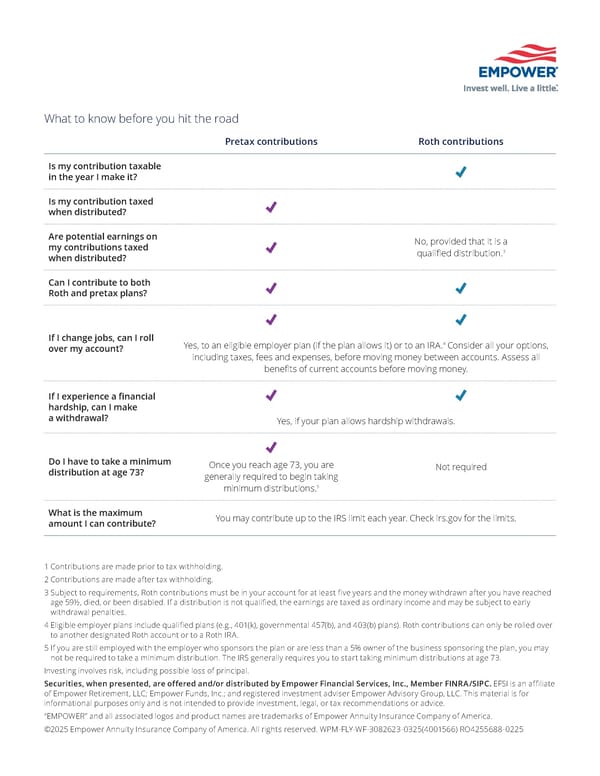
1 Contributions are made prior to tax withholding. 2 Contributions are made after tax withholding. 3 Subject to requirements, Roth contributions must be in your account for at least five years and the money withdrawn after you have reached age 59½, died, or been disabled. If a distribution is not qualified, the earnings are taxed as ordinary income and may be subject to early withdrawal penalties. 4 Eligible employer plans include qualified plans (e.g., 401(k), governmental 457(b), and 403(b) plans). Roth contributions can only be rolled over to another designated Roth account or to a Roth IRA. 5 If you are still employed with the employer who sponsors the plan or are less than a 5% owner of the business sponsoring the plan, you may not be required to take a minimum distribution. The IRS generally requires you to start taking minimum distributions at age 73. Investing involves risk, including possible loss of principal. Securities, when presented, are offered and/or distributed by Empower Financial Services, Inc., Member FINRA/SIPC. EFSI is an affiliate of Empower Retirement, LLC; Empower Funds, Inc.; and registered investment adviser Empower Advisory Group, LLC. This material is for informational purposes only and is not intended to provide investment, legal, or tax recommendations or advice. “EMPOWER” and all associated logos and product names are trademarks of Empower Annuity Insurance Company of America. ©2025 Empower Annuity Insurance Company of America. All rights reserved. WPM-FLY-WF-3082623-0325(4001566) RO4255688-0225 What to know before you hit the road Pretax contributions Roth contributions Is my contribution taxable in the year I make it? Is my contribution taxed when distributed? Are potential earnings on my contributions taxed when distributed? No, provided that it is a qualified distribution. 3 Can I contribute to both Roth and pretax plans? If I change jobs, can I roll over my account? Yes, to an eligible employer plan (if the plan allows it) or to an IRA. 4 Consider all your options, including taxes, fees and expenses, before moving money between accounts. Assess all benefits of current accounts before moving money. If I experience a financial hardship, can I make a withdrawal? Yes, if your plan allows hardship withdrawals. Do I have to take a minimum distribution at age 73? Once you reach age 73, you are generally required to begin taking minimum distributions. 5 Not required What is the maximum amount I can contribute? You may contribute up to the IRS limit each year. Check irs.gov for the limits.
 401 K - SWIA & Empower Page 15 Page 17