
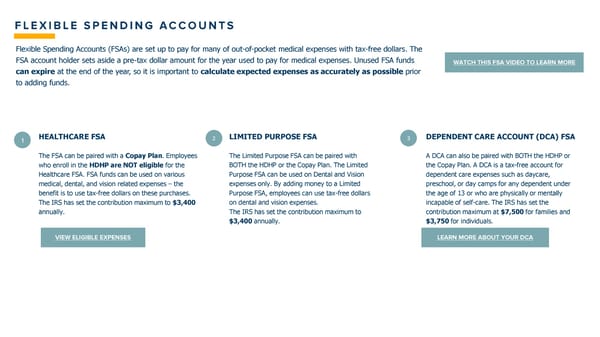
Flexible Spending Accounts (FSAs) are set up to pay for many of out - of - pocket medical expenses with tax - free dollars. The FSA account holder sets aside a pre - tax dollar amount for the year used to pay for medical expenses. Unused FSA funds can expire at the end of the year, so it is important to calculate expected expenses as accurately as possible prior to adding funds. 1 HEALTHCARE FSA The FSA can be paired with a Copay Plan . Employees who enroll in the HDHP are NOT eligible for the Healthcare FSA. FSA funds can be used on various medical, dental, and vision related expenses the benefit is to use tax - free dollars on these purchases. The IRS has set the contribution maximum to $3,400 annually. 2 LIMITED PURPOSE FSA The Limited Purpose FSA can be paired with BOTH the HDHP or the Copay Plan. The Limited Purpose FSA can be used on Dental and Vision expenses only. By adding money to a Limited Purpose FSA, employees can use tax - free dollars on dental and vision expenses. The IRS has set the contribution maximum to $3,400 annually. 3 DEPENDENT CARE ACCOUNT (DCA) FSA A DCA can also be paired with BOTH the HDHP or the Copay Plan. A DCA is a tax - free account for dependent care expenses such as daycare, preschool, or day camps for any dependent under the age of 13 or who are physically or mentally incapable of self - care. The IRS has set the contribution maximum at $7,500 for families and $3,750 for individuals.
 Open Enrollment 2026 Benefits Guide Page 19 Page 21